
Basic Information
Scientific classification
- Chinese name: Emperor Woodpecker
- Scientific name: Imperial woodpecker, Campephilus imperialis
- Classification: Climbing birds
- Family and genus: Order Piliformes, Family Pilidae, Genus *Red-headed Woodpecker*
Vital signs data
- Body length: up to 60 cm
- Weight: No verification information available.
- Lifespan: No verification data available.
Significant features
It is the largest known woodpecker.
Distribution and Habitat
The Emperor Woodpecker is native to northern Mexico and lives in mountain forests at altitudes of 1920–3050 m, with records also found at altitudes of over 1600 m. It typically inhabits mixed coniferous forests of Durango pine, Mexican white pine, loblolly pine, and Montfernae pine.
Appearance
The male Emperor Woodpecker has a bright red crest, while the female is black. The plumage of both sexes is primarily black and white, with white tips on the inner primary flight feathers, entirely white secondary flight feathers, and white scapular feathers extending to the back of the neck. The beak is ivory white.
Detailed introduction
The Emperor Woodpecker, scientifically known as Campephilus imperialis, is the largest woodpecker.
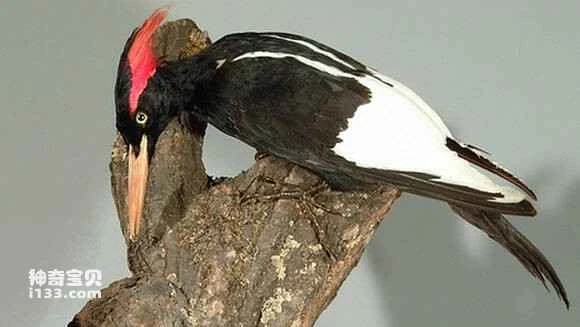
A pair of Emperor Woodpeckers needs at least 26 square kilometers of extensive woodland to breed. Outside the breeding season, Emperor Woodpeckers will choose to forage alone or in groups of up to 12 individuals, depending on the availability of food.
The Emperor Woodpecker is listed as Critically Endangered ("Probably Extinct") on the IUCN Red List, meaning that in addition to being extremely endangered, there is practically no conclusive evidence that the bird is still alive. The last reliable record was in 1956, observed in Durango State. Subsequent observations were sporadic in 1965, 1993, 1995, and 1996, but whenever researchers conducted detailed searches at the sighting locations based on intelligence, they returned empty-handed. While scholars believe that some individuals may still survive, their extremely small numbers and fragmented habitat are insufficient to sustain the species' continued existence.
The dramatic decline in this bird's population is attributed to several factors, including habitat destruction. Because these woodpeckers rely on old pine trees and require a large living area, deforestation and other development activities have had a devastating impact on them. Furthermore, overhunting has occurred due to the local Tarahumara people's use of the emperor woodpecker in traditional medicine and the consumption of young birds. Studies also indicate that many people shoot them simply to get a closer look at this beautiful bird.
Based on multiple observation reports after 1956, Lammertink et al. inferred that this bird was still alive in the 1990s, mainly distributed in the central part of its historical distribution area. During this period, there were no reliable records and a lack of relevant research data. After the 1990s, due to the catastrophic decline in population, although its close relative, the ivory-billed woodpecker, was re-emerged in 2005, it is now almost impossible to find this bird half a century later.
There are about 120 museum specimens of the Emperor Woodpecker around the world, but not a single photograph or video clip of a living Emperor Woodpecker has survived.
Protect wild animals and ban the consumption of wild game.
Maintaining ecological balance is everyone's responsibility!


